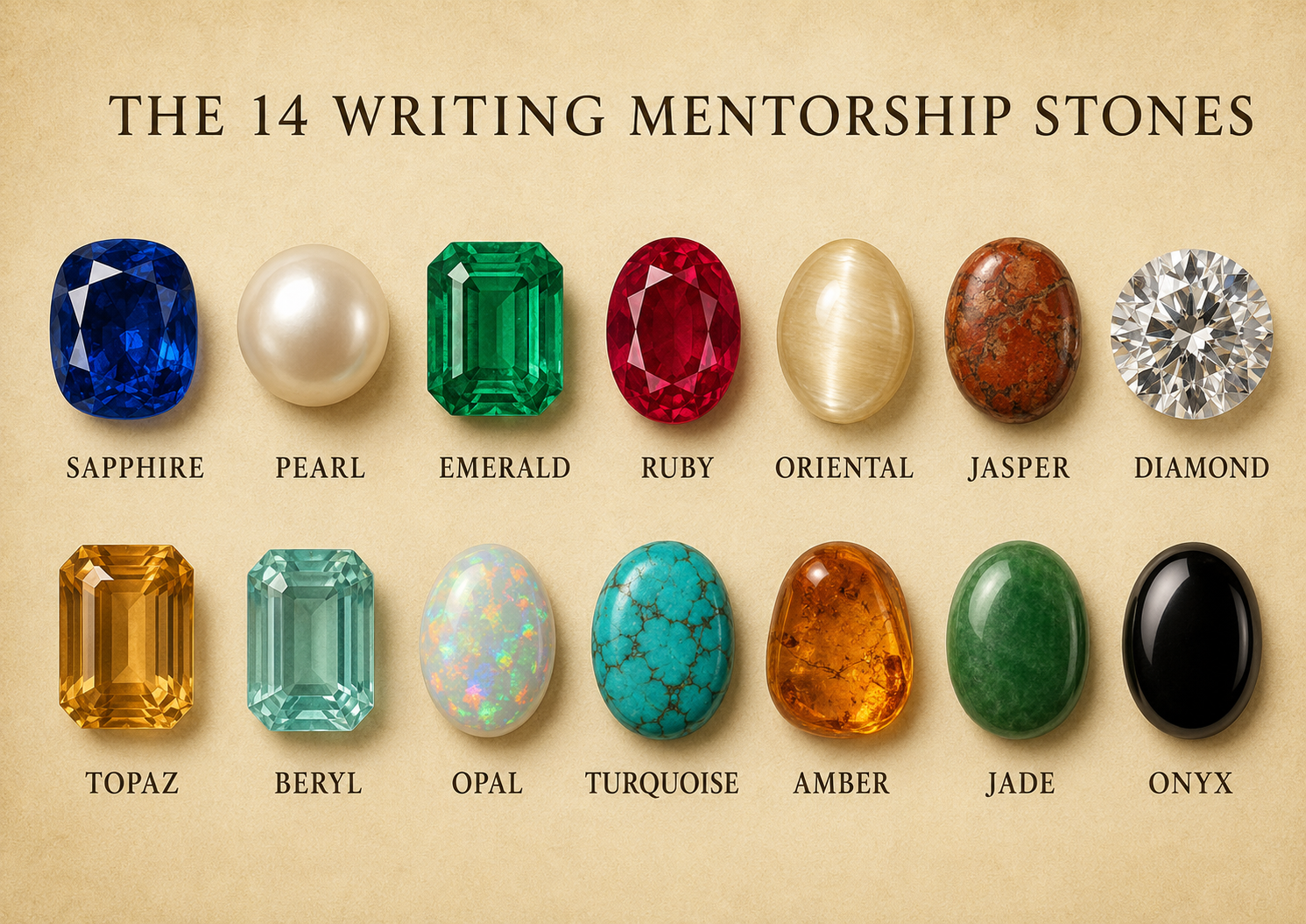
Writing Mentorship Stones and Their Relevance to Writers
Writing is not merely the putting together of words. It is a refining of thought, a discipline of the heart, a stewardship of voice, and often, a long journey of becoming. Like precious stones formed under pressure, writers are shaped through time, correction, courage, study, silence, and faithful obedience to the message God has placed within them.
The Writing Mentorship Stones can serve as symbolic reminders of the qualities every writer needs in order to grow from a hesitant beginner into a purposeful, skilled, and impactful author.
1. Sapphire — The Stone of Wisdom and Clarity
Sapphire represents wisdom, depth, and clear vision. For a writer, this stone reminds us that writing must not only sound beautiful but also carry understanding.
A writer needs clarity of thought before clarity of expression. Many manuscripts struggle not because the author lacks passion, but because the message has not yet been fully refined. Sapphire calls the writer to pause, think deeply, research carefully, pray sincerely, and write from a place of understanding.
In mentorship, Sapphire represents the stage where a writer learns to ask, “What am I truly trying to say?” Before the book can bless readers, the writer must first understand the message.
2. Pearl — The Stone of Hidden Formation
A pearl is formed quietly, hidden from public view. It begins with irritation and pressure, yet over time becomes something precious.
This is deeply relevant to writers. Many great books are born from pain, questions, disappointments, waiting seasons, testimonies, and lessons learned in private. What once wounded the writer can become wisdom for the reader.
Pearl reminds writers not to despise hidden seasons. The unpublished years, the rejected drafts, the quiet journalling, the unfinished chapters, and the painful edits are all part of formation. A writer must allow God to turn life’s irritations into messages of grace.
3. Emerald — The Stone of Growth and Freshness
Emerald symbolises growth, renewal, and flourishing. Writing is a growing craft. No writer begins fully formed.
Emerald reminds writers to remain teachable. A writer who refuses correction remains small, but one who receives mentorship, editing, and honest feedback grows stronger with every draft.
For writers, Emerald represents fresh language, renewed perspective, and the courage to keep improving. It reminds us that every manuscript can become greener, richer, and more alive when the writer allows the work to be cultivated.
4. Ruby — The Stone of Passion and Courage
Ruby represents fire, boldness, and passion. Every writer needs inner fire. Without passion, writing becomes flat. Without courage, many important stories remain untold.
Ruby speaks to the writer who has something burning inside but is afraid to release it. It reminds the author that their voice matters. Some books require courage because they confront culture, expose brokenness, tell painful truths, or declare God’s Word in a resistant generation.
In mentorship, Ruby represents the strengthening of the writer’s conviction. It asks, “What burden has God placed on your heart, and are you willing to carry it faithfully?”
5. Oriental — The Stone of Beauty, Mystery, and Cultural Richness
Oriental, as a symbolic mentorship stone, represents beauty from the East, mystery, richness, and the honouring of diverse cultural expression.
For African Christian writers, this stone is especially meaningful. It reminds us that our stories do not need to imitate another people’s voice in order to be valuable. Our proverbs, landscapes, languages, family systems, village memories, city struggles, spiritual journeys, and cultural wisdom all carry literary treasure.
Oriental calls writers to embrace beauty beyond the familiar. It encourages authors to write with colour, atmosphere, heritage, and depth. A manuscript becomes more powerful when the writer does not erase their background but allows it to enrich the message.
6. Jasper — The Stone of Endurance and Stability
Jasper represents strength, grounding, and endurance. Writing requires more than inspiration. It requires discipline.
Many people begin books. Fewer finish them. Even fewer revise them. Jasper reminds the writer to keep showing up. One page today, one paragraph tomorrow, one corrected chapter next week; slowly, the book is built.
In mentorship, Jasper represents structure. Writers need writing schedules, chapter outlines, accountability, and the humility to work even when the excitement has faded. Jasper says, “Do not only be inspired. Be faithful.”
7. Diamond — The Stone of Refinement and Excellence
Diamond is formed under immense pressure and becomes brilliant through cutting and polishing. This is the perfect image of editing.
A manuscript is not weakened by editing; it is strengthened. The cutting away of repetition, confusion, unnecessary words, weak structure, and unclear arguments allows the true brilliance of the message to shine.
Diamond reminds writers that excellence honours both God and the reader. A powerful testimony still needs good grammar. A divine message still needs structure. A heartfelt story still needs craft. The writer must not fear the polishing process.
8. Topaz — The Stone of Light and Expression
Topaz symbolises warmth, creativity, and illumination. Writers are called to bring light through words.
A writer helps readers see what they had not seen before. Through stories, devotionals, poems, teachings, memoirs, and essays, writers shine light on truth, healing, purpose, identity, and hope.
Topaz reminds writers to use words responsibly. Words can confuse or clarify, wound or heal, entertain or transform. The mentored writer learns to make their writing luminous, not merely loud.
9. Beryl — The Stone of Focus and Precision
Beryl represents focus, refinement, and mental sharpness. Many writers have many ideas, but not every idea belongs in the same book.
Beryl teaches the discipline of focus. A book must know its assignment. Is it a memoir, devotional, leadership guide, children’s story, Bible study, or teaching manual? Who is the reader? What problem is being addressed? What transformation should happen by the end?
In mentorship, Beryl helps the writer avoid scattering. A focused book is easier to write, easier to edit, easier to publish, and easier for readers to recommend.
10. Opal — The Stone of Creativity and Many Colours
Opal carries many colours, making it a fitting symbol for imagination and creative expression.
Every writer has a unique voice. Some write with humour, others with tenderness. Some are poetic, others are practical. Some build worlds through fiction, while others explain truth through teaching. Opal reminds writers that creativity is not one colour.
For the writer, Opal says, “Do not flatten your voice.” The world does not need every Christian author to sound the same. God uses different personalities, backgrounds, and writing styles to reach different readers.
11. Turquoise — The Stone of Communication and Connection
Turquoise represents communication, protection, and relational beauty. Writing is not only self-expression; it is connection.
A writer must learn to think about the reader. Will they understand this? Will they feel invited? Is the tone too harsh, too vague, too academic, or too casual for the intended audience?
Turquoise reminds writers to build a bridge between the message and the reader. A book is not a private diary once it is published. It becomes ministry, conversation, invitation, and sometimes correction. The writer must communicate with grace.
12. Amber — The Stone of Memory and Preservation
Amber preserves what once lived. It is a beautiful symbol for memoir, testimony, history, and legacy.
Writers preserve stories that would otherwise be forgotten. They capture family wisdom, cultural memory, spiritual encounters, painful journeys, miracles, lessons, and turning points. Without writers, many testimonies disappear silently.
Amber reminds writers that their words can outlive them. A book can speak to children, grandchildren, communities, churches, and nations long after the writer has left the room. This gives writing both urgency and dignity.
13. Jade — The Stone of Balance and Maturity
Jade symbolises balance, harmony, and maturity. Writers need balance in both message and method.
A writer must balance truth with grace, passion with patience, creativity with structure, and confidence with humility. Too much emotion without order can overwhelm the reader. Too much information without warmth can feel dry. Too much correction without compassion can wound rather than heal.
Jade reminds writers to mature in tone. A strong writer does not need to shout on every page. Sometimes quiet wisdom carries more authority than noise.
14. Onyx — The Stone of Depth and Resilience
Onyx represents depth, strength, and resilience. It speaks to the writer who must continue even when the journey becomes difficult.
Writing can expose insecurities. It can bring comparison, delays, criticism, rejection, financial pressure, and spiritual warfare. Onyx reminds the writer to remain grounded.
Not every reader will understand your assignment. Not every door will open quickly. Not every draft will work the first time. Still, the writer must continue with depth, sobriety, and faith.
Onyx is the mentorship stone of perseverance. It says, “Stand. Finish. Rewrite. Submit. Try again.”
Conclusion: The Writer as a Living Stone
These mentorship stones remind us that a writer is also being written upon by God. The manuscript is not the only project; the author is also under construction.
Sapphire gives wisdom.
Pearl gives patience.
Emerald gives growth.
Ruby gives courage.
Oriental gives cultural richness.
Jasper gives endurance.
Diamond gives excellence.
Topaz gives light.
Beryl gives focus.
Opal gives creativity.
Turquoise gives connection.
Amber gives legacy.
Jade gives balance.
Onyx gives resilience.
Together, they form a picture of the complete writer: thoughtful, teachable, courageous, disciplined, creative, grounded, and faithful to the message entrusted to them.
A writer who embraces these stones does not merely chase publication. They pursue transformation. They do not only ask, “Can I write a book?” They begin to ask, “What kind of vessel must I become so that this book may serve its reader well?”
That is the heart of writing mentorship.
Subscribe for wholesome content!