
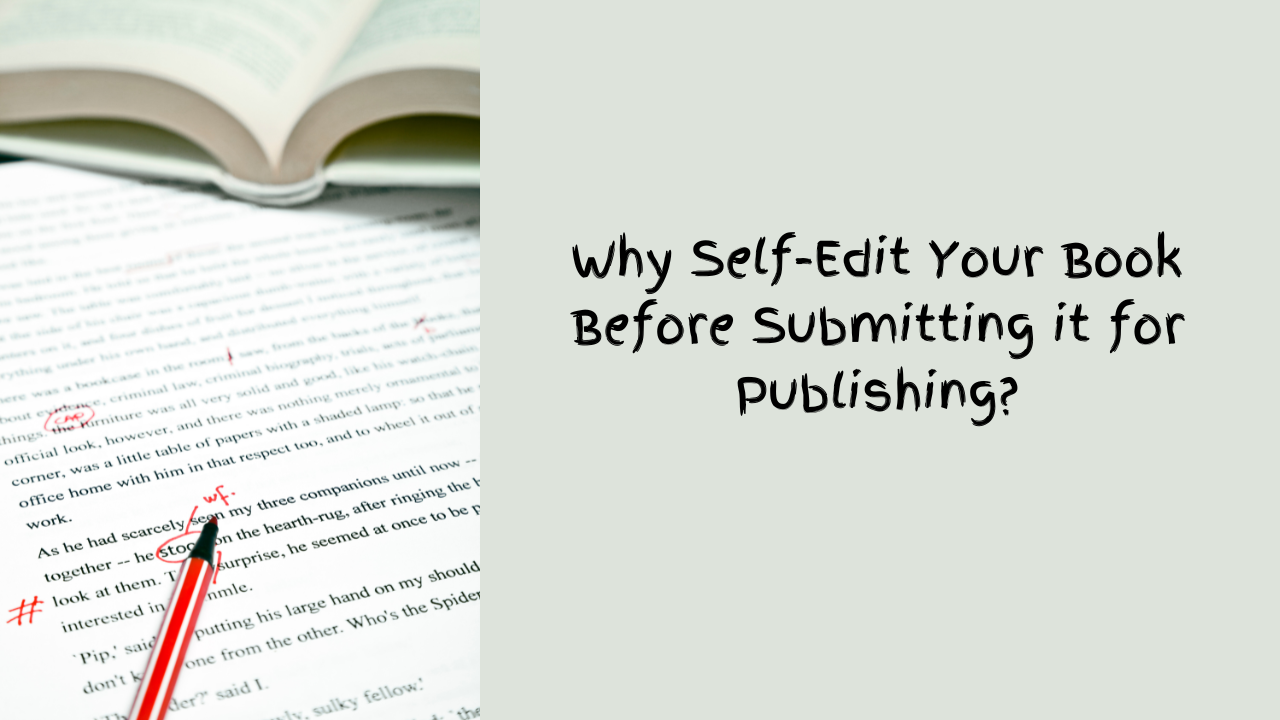
Self-editing is a crucial step before submitting your manuscript for publishing. It allows you to refine your ideas, correct errors, and enhance the overall quality of your work. A well-edited manuscript not only demonstrates professionalism but also makes the publishing process smoother and more efficient. From grammar to flow and...
Read More- Home
- Authors, Books & Conversations
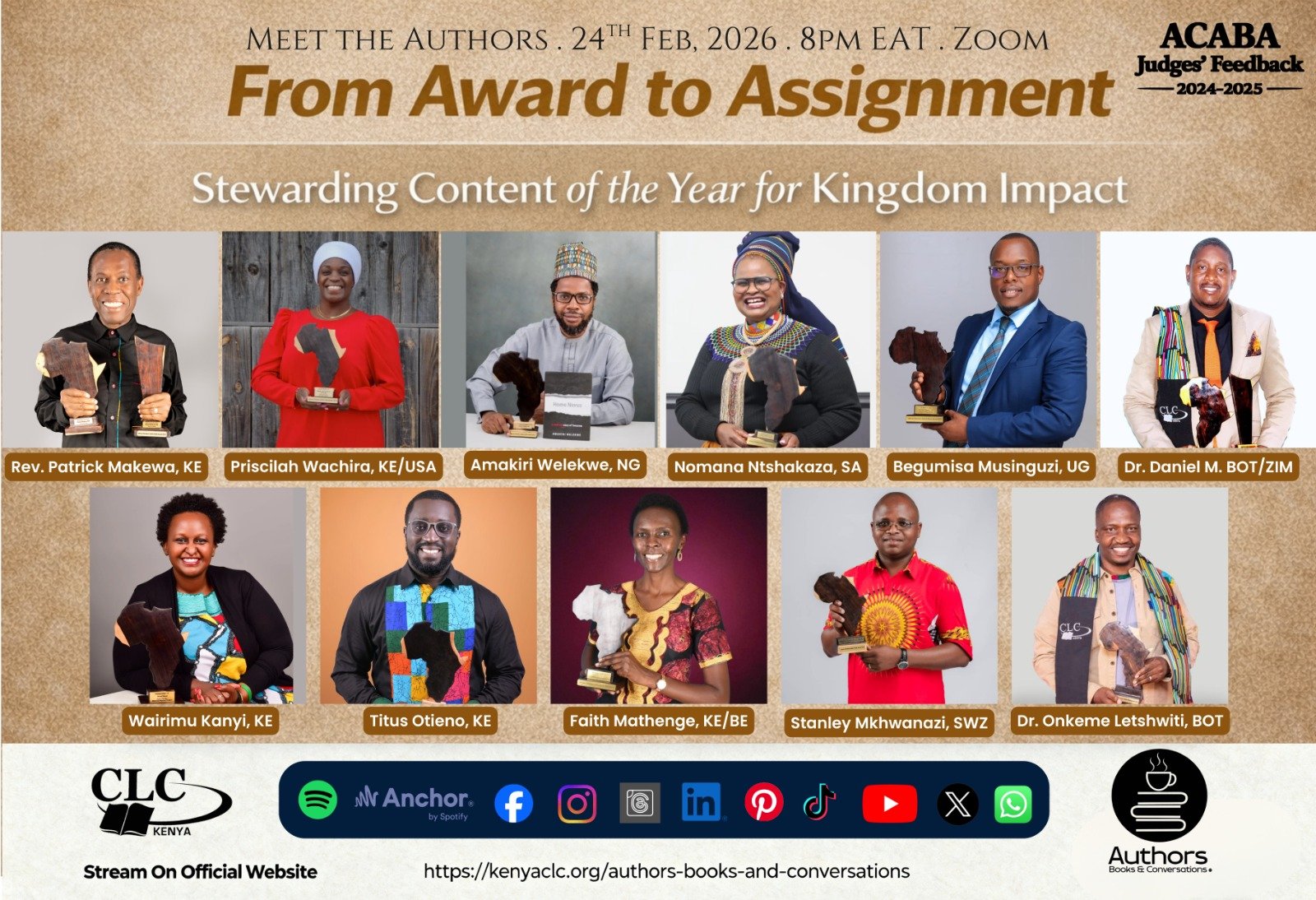
- From Award to Assignment: Stewarding Content of the Year for Kingdom Impact
Featuring: Roselyne Kanyi (Kenya), Musinguzi Begumisa (Uganda), Faith Mathenge (Kenya/Belgium), Dr. Daniel Matematema (Botswana/Zimbabwe), Stanley Mkhwanazi (Eswatini), Dr. Onkeme Letshwiti (Botswana), Nomana Ntshakaza (South Africa), Priscilla Wachira (Kenya/USA), Amakiri Welekwe (Nigeria), Titus Otieno (Kenya), Rev. Makewa Patrick (Kenya)
Register in Advance
Registration closes 1 minute to the set time on the D-day.
Register on ZoomTip: If you don’t see the email, kindly check Promotions/Spam.
Authors, Books & Conversations
From Award to Assignment: Stewarding Content of the Year for Kingdom Impact
Date & Time:
Tuesday 24th February, 2027 — 8:00pm EAT
Venue:
Zoom (video on)
For readers, this is your front-row seat to listen to the hearts behind the books—why these authors wrote what they wrote, what God was teaching them, and how the message is meant to serve lives beyond the final page.
For authors, it is a practical and encouraging guide to what happens after the win and how to keep your book “alive” through discipleship-minded platforms and intentional engagement.
Want the full context before the session?
Read the article first, then bring your questions to Zoom.
Jump to the Article
Opens the article link
Watch below
Click the poster to start the video player
Award Winning Books
Listen to the Podcast: From Award to Assignment: Stewarding Content of the Year for Kingdom Impact
🎧 Listen to the Podcast
EPISODE SPONSORS
Today’s episode is proudly sponsored by CLC USA under the Ken & Bessie Adams Legacy Award for Content of the Year. CLC USA exists to glorify God by making Christ known through the written Word—supporting the publishing, distribution, and promotion of Scripture-rooted resources that strengthen believers, equip churches, and advance the Gospel across nations.
Welcome to Authors, Books & Conversations by CLC Kenya
the podcast that celebrates the power of storytelling, the beauty of literature, and the impact of Christian authorship. I am your host, Dr. Muthoni Omukhango, and I am delighted to take you on a journey through some of the most inspiring books featured in the African Christian Authors Book Award (ACABA).
Today’s episode is both a celebration and a charge. We are spotlighting award-winning content, yes—but we are also asking the deeper question: What happens after the award? What does it look like to move from recognition to responsibility, from applause to assignment, from “Congratulations!” to “Go and disciple.”
Our theme is: From Award to Assignment: Stewarding Content of the Year for Kingdom Impact.
In this conversation, we will be hearing from authors whose books have been recognised by ACABA—voices from across Africa and the diaspora—carrying messages that have not only inspired readers, but have also been affirmed for their depth, clarity, and spiritual weight.
But here is where it gets wonderfully serious (in the best way). An award is not a finish line. It is a spotlight—and God rarely shines a spotlight for entertainment. He shines it for stewardship.
So today we will be exploring what it means to steward “Content of the Year” in a way that produces lasting Kingdom fruit:
How do you keep the message alive beyond the ceremony—through discipleship-minded platforms, intentional engagement, and faithful consistency?
How do you protect the purity of what God entrusted to you, while still allowing it to grow, travel, and reach new people?
How do you navigate opportunities, invitations, and visibility without turning assignment into performance?
And for readers—how do you support, interact with, and amplify books that are truly building faith in our homes, churches, and communities?
Because strong content is not meant to sit quietly on a shelf. It is meant to work—to comfort, correct, strengthen, teach, and point people to Christ. And let us be honest: many authors long for impact, but they are not always sure what faithful stewardship looks like after the “big moment.” This session is here to provide language, direction, and encouragement.
Stay with us as we unpack this vital conversation, featuring award-winning books and the authors behind them—men and women stewarding testimony, truth, and teaching with courage and grace.
Now, let’s dive in.
“An award may recognise the message—but an assignment requires that you carry it.”
ACABA by CLC Kenya is a program that recognises, celebrates and promotes African Christian authors whose works inspire, equip, and transform lives. Each year, a panel of judges carefully evaluates submissions based on originality, Biblical alignment, relevance, and literary excellence. In this special episode, we will review five outstanding books, highlighting their impact and the judges’ feedback. Join me as we dive into these literary treasures!
African Books With Award Winning Content
Why Are African Books & Conversations Important Today?
African books and the conversations surrounding them are more important than ever in today’s world to Preserve and Celebrate African Stories: For centuries, Africa’s rich oral traditions, history, and wisdom have been passed down through storytelling. Now, books serve as an extension of that legacy, capturing authentic African experiences and ensuring they are not lost. African literature provides a unique lens through which we understand our past, navigate our present, and shape our future as we draw our continent to God!
tags : Book Content, Award Winners, African Books, ACABA Judges Feedback, Great Reads
socials :

From Award to Assignment: What the Eleven Award-Winning Books Have in Common
What do these eleven award-winning books have in common?
They did not stop at excellence in writing—they embraced excellence in stewardship.
An award recognises quality. An assignment demands responsibility. That is the difference.
When a book receives recognition for Content of the Year, it signals that the message carries depth, clarity, theological soundness, relevance, and impact. But recognition is only the beginning. The real question is: What happens next?
That is where “From Award to Assignment” becomes more than a theme—it becomes a posture.
So what does it mean to steward “Content of the Year” for Kingdom impact?
It means understanding that the message entrusted to you is not a personal achievement—it is a divine responsibility. Awards may affirm the work, but assignments expand it.
Across these eleven books, several common threads emerge:
1. The Message Is Bigger Than the Moment
These authors did not write to win awards. They wrote to solve problems, disciple believers, confront cultural confusion, strengthen marriages, shape leaders, heal wounds, and point people to Christ.
The award simply amplified what was already weighty.
When content is assignment-driven, it carries conviction. And conviction travels further than hype.
2. The Authors Remain Students, Not Celebrities
Award-winning content does not create spiritual superiority. It demands deeper humility.
The strongest voices among these authors are those who:
continue refining their craft
remain accountable to Scripture
receive feedback
engage readers meaningfully
steward platforms wisely
An award may increase visibility. But stewardship sustains credibility.
3. The Book Is Treated as a Living Tool
These books are not resting on shelves. They are being:
discussed in book clubs
used in discipleship groups
referenced in sermons
integrated into training
shared across borders
That is assignment at work.
Stewardship means asking:
How can this message serve beyond the page?
Content of the Year becomes Kingdom impact when it moves from print to practice.
4. Recognition Requires Readiness
One often overlooked truth is this: shining content does not happen accidentally. It begins long before submission, long before judging, long before awards.
The authors whose work rises to the top usually began with discipline at the manuscript stage. They laboured over clarity. They revised. They tightened arguments. They removed repetition. They strengthened structure. They honoured the reader before asking to be recognised by them.
Awards celebrate polished content. But polish begins in private.
If you desire to produce content that shines from the start, learn the discipline of self-editing before submitting your manuscript for publishing. Study the practical guide on why and how to self-edit so that your message is clear, credible, and strong before it ever reaches a reviewer’s desk:
https://kenyaclc.org/why-self-edit-your-book-before-submitting-it-for-publishing/?v=a2e1f137298d
Excellence at the beginning increases impact at the end.
5. The Content Remains Rooted in Scripture
What ultimately sets Kingdom content apart is not stylistic brilliance alone. It is Scriptural anchoring.
These books carry:
doctrinal clarity
biblical foundations
practical faith application
redemptive perspective
In a crowded literary marketplace, Scripture-rooted content stands firm.
Awards recognise quality. Stewardship multiplies it. Discipline sustains it.
An award may recognise the message.
An assignment requires that you carry it faithfully.

Conclusion & Call to Action
What a weighty and necessary conversation. Today’s episode has reminded us that winning an award is not the climax of the journey—it is the beginning of a greater responsibility. Recognition may affirm your content, but stewardship determines its impact.
“Content of the Year” is not simply a title. It is a trust. It signals that your message carries clarity, depth, Scriptural grounding, and relevance. But once the applause fades, the real work begins. How will this message travel? Who will it disciple? How will it continue shaping lives beyond the ceremony?
Stewardship means refusing to let powerful content grow silent. It means engaging readers intentionally, building discipleship pathways around your book, collaborating wisely, speaking where invited, and remaining anchored to the burden that birthed the message in the first place. An award may increase visibility—but assignment requires consistency.
If you are an African Christian author, let today’s discussion challenge you to examine your posture. Are you preparing your manuscript with discipline from the start? Are you refining your work before submission? Are you writing with eternity in mind—or merely aiming for recognition?
Excellence is not accidental. It is cultivated. And it begins long before judging panels ever see your work. If you desire to produce shining content from the very first draft, strengthen your foundation. Learn the discipline of self-editing and refining your manuscript before submission. Study the guide on why and how to self-edit so that your message is clear, credible, and impactful from the start:
https://kenyaclc.org/why-self-edit-your-book-before-submitting-it-for-publishing/?v=a2e1f137298d
Platforms like ACABA exist not only to recognise excellence, but to cultivate it—to strengthen authors across Africa who are serious about stewarding their calling with integrity and skill.
Thank you for listening to Authors, Books & Conversations. If today’s episode sharpened your perspective on authorship and assignment, share it with a fellow writer or reader, leave us a review, and subscribe so you never miss conversations that refine both calling and craft.
Until next time, write with conviction, publish with excellence, steward your assignment faithfully—and keep reading.
Podcast Produced by: CLC Kenya
Host: Dr. Muthoni Omukhango
Post Views: 167
Subscribe for wholesome content!

Useful Links
Subscribe Now
Don’t miss our future updates! Get Subscribed Today!

×